Thursday, April 1, 2010

Manga Illustrator to Inspire Interest in Science

source:http://www.livescience.com/culture/manga-illustrator-science-mayhew-100331.html

By Jeremy Hsu, LiveScience Contributor

posted: 31 March 2010 09:15 am ET


Japanese manga comics have gradually infiltrated the bookstore shelves and popular culture of the United States and the rest of the world. But rather than just create entertaining stories, one manga illustrator hopes to use the popular storytelling medium to boost skeptical thinking and interest in science among fans, especially girls.

The manga series, titled "Legend of the Ztarr," draws inspiration from "Star Trek" and "Star Wars" among other stories. Yet its creator also cites influences from the "shoujo" manga stories that aim at a readership consisting of female teens, and often resemble romantic comedies.

Manga comics embrace all genres and have attracted a growing international audience. Some manga versions of science textbooks have even come out with English translations, but few if any of the "shoujo" stories aimed at female teens touch on science or empirical thinking.

One illustrator hopes to change that.

"'Legend of the Ztarr' is an epic — like 'Lord of the Rings' in space! Except, 'Legend of the Ztarr' is the skeptic's epic," said Sara Mayhew, a manga illustrator who lives in Kirkland Lake, Canada.

Mayhew presented her idea at TEDActive conference held at Palm Springs, Calif., in February. It's a sister event to the annual TED conference, which features talks from creative thinkers and innovators who have included"Avatar" director James Cameron and Microsoft-founder Bill Gates.

The proposal has appeal in part because manga has attracted plenty of female fans with certain romance or emotion-centered series, and continues to draw in such readers with new tie-ins such as a recently announced "Twilight" manga adaptation. Such stories could also possibly help female readers take an interest in science and skeptical thinking, if done well.

By contrast, the U.S. comic book industry has traditionally appealed more to a male geek culture — not unlike how certain scientific fields still have male-dominated cultures.

Simple appearances can make a huge difference. Mayhew recalled being a young girl and seeing "Star Wars" concept art for the original movies that envisioned the hero as a heroine, back when "Star Wars" creator George Lucas toyed with the idea of a female lead.

"That idea and image really stuck with me — Star Wars with a female Luke Skywalker," Mayhew told LiveScience. Some "Star Wars" elements appear in "Legend of the Ztarr," such as young hero (or heroine) pining for adventure while stuck on a distant planet,

"Legend of the Ztarr" also bears resemblance to "Star Wars" by focusing on a story that just happens to have a galactic backdrop, rather than "Star Trek" where certain story elements depend more on real-world science principles. That means "Legend of the Ztarr" probably won't teach any biology or physics, but may instead inspire readers — especially female readers —through fictional role models who have scientific or evidence-based mindsets.

Mayhew noted that stories can convey skeptical or critical thinking through characters, even without being overtly about science. She pointed to the "Harry Potter" series as a bit of a counterintuitive example of fantasy teaching evidence-based thinking.

"Even though the characters can use magic, they still think their way out of problems and are good skeptics; they have a passion of solving mysteries but use critical thinking," Mayhew said.

Mayhew's own interest in science and skeptical thinking grew alongside her practice of drawing and storytelling. She pointed to the "Bad Astronomy" blog as one of the first science and skepticism blogs she encountered, and expressed an ongoing love with astronomy and anything written by the late astronomer Carl Sagan. She also regularly listens to podcasts such as "Skeptics' Guide to the Universe" and SETI's "Are We Alone."

For now, Mayhew has already published a chapter of "Legend of the Ztarr" online, and hopes to eventually land a U.S. publisher for her work. Her earlier series, "Secrets of Sorcerors," was deemed "Best Comic for Teens" by the International Anime and Manga Festival.

Manga has already helped encourage young readers' interests in other areas as well. Classic literature such as "The Scarlet Letter" and "The Adventures of Huckleberry Finn" has already undergone the manga treatment. UK publisher SelfMadeHero has also spun off its own manga adaptations of Shakespeare plays, with twists such as transforming "Romeo and Juliet" into a story of feuding yakuza gangs in Tokyo.

"What I like about manga is how unrestrictive it is in the kinds of stories that are told," Mayhew said.

Manga: Comic romance is big in Japan

source:http://www.canadianbusiness.com/after_hours/lifestyle_products/article.jsp?content=20100412_10015_10015

Adapting its format to Japanese tastes, Harlequin succeeds in the manga business.

By Laura Cameron

Stephen Miles, executive vice-president of overseas operations for Toronto-based Harlequin Enterprises travels one week out of every month, visiting two or three countries on each trip. “When I watch the movie Lost In Translation, I tell my kids, ‘That’s my job,’” says Miles. The task of exporting romance novels around the world involves preserving the characteristics of Harlequin’s product that make it universally appealing — the classic love story — and adapting aspects of the business that change depending on the market, such as how the content is formatted and distributed. But in spite of the need to strike this balance, Miles insists that it is not a complex business.

Arriving in Japan, Miles says, it didn’t take a rocket scientist to realize Torstar-owned Harlequin needed to change its format to penetrate the Japanese market — more than 50% of adult fiction in Japan is read in a comic-book form called manga. Manga, which translates literally to “whimsical pictures,” is a Japanese genre of comics that is read by people of all ages. The 1990s anime TV series Sailor Moon became well-known in the West as an animated version of a modern romance manga by Naoko Takeuchi. According to a Tokyo-based research company, Impress R&D, the Japanese manga industry took in $380 million in revenue in the last fiscal year.

“If you go into a bookstore in Japan — and they’re on every street corner — half the store is comics,” says Miles. “It made sense for us to publish our books in comic form.”

But Harlequin decided to stick with what they know — the text business — and license their stories to a Japanese comic-book publisher to see what they could learn from the market. Its partner, Ohzora Publishing, took English-language Harlequin romances, had them translated into Japanese and contracted an artist to illustrate them in manga style.

The manga business was successful under Ohzora, and in 2006 when Harlequin launched e-books in Japan, the decision followed naturally to distribute digital comics as well. According to Miles, Harlequin took over publishing manga because Ohzora was unwilling to invest in and grow the business.

Harlequin saw a big opportunity in digital manga, and was quick to recognize that mobile phone technology was an important trend in Japan, where data transfer is fast and cheap, thanks to a one gigabyte-per-second fibre-based network. The transfer of manga illustrations is fairly data-intensive, but because the mobile Internet is so advanced in Japan, comics can be read easily on a cellphone. Additionally, Japanese characters make it possible to read more text on a small screen than other languages. To facilitate this new way of distributing content, Harlequin partnered with SoftBank Creative, the third-largest mobile company in Japan.

Today, Japan is the largest market in Harlequin’s overseas business. Digital manga sales were more than $10 million in 2009, up more than 100% from 2008. Nearly all of these sales were in Japan, but according to Miles there is a large market for digital manga all over Asia. Harlequin is expanding its business with its partner SoftBank — last year they moved into Korea, and currently they are working on expanding in China. This year they will tackle Taiwan, France and the U.S.

The potential for growth is not as big in western countries, where manga is, at most, a niche market. Harlequin is focusing on growing its e-books business in the West, where mobile phone technology is less advanced and e-readers are becoming more popular. Presently, it is launching its electronic front list in the United Kingdom, France and Australia.

Although Harlequin has been quick to adapt to different markets and changes in distribution models, the main reason the company has been successful is the romance novel’s enduring appeal to women. Harlequin is the only publisher that targets women exclusively, which Miles says enables it to do highly focused research. “We know a lot about our customers,” he says. Sticking to their core business also enabled it to fare better than other fiction publishers during the recession. It provides women with an inexpensive escape. “Boy meets girl and they stay in love forever,” says Miles. “It’s a simple model but it works.” And the most important element in the romance novel business, of course, is “they’re all really happy endings.”

China challenges Japan in anime

source:http://www.philly.com/inquirer/magazine/20100401_China_challenges_Japan_in_anime.html

TOKYO - Yoko Komazawa had been at the Tokyo International Anime Fair for nearly six hours when she fell in love with a brown-and-white stuffed panda - a character in one of the fair's featured cartoons.

"It's so adorable and interesting," she said, staring into its gleaming pink eyes. "I want it."

Unfortunately, the panda wasn't for sale and Komazawa had to settle for a photo. But she walked away from the small booth impressed by the panda's creators - from China.

"Japan is certainly an amazing anime country," said the 30-something anime fan and collector of all things cute and cuddly. "China has some intriguing characters, though. They're different, and that definitely catches my attention."

Komazawa's enthusiasm for something new is a small victory for China's fledgling animation industry, and could well represent a widening crack in Japan's global anime dominance. Japan may be the birthplace of anime, but China is gunning for its future as it mounts an aggressive effort to expand the country's creative prowess and reputation.

In November, the government's cultural arm established the China Animation Comic Group Co. to foster a "great leap forward" in animation production, technology and marketing. Part of the plan includes building a "China Animation Game City" in Beijing that would be a national hub.

With government subsidies, Chinese animation companies tripled their presence at this year's Tokyo anime fair even as the overall number of exhibitors declined. The four-day event that ended March 28, one of the world's biggest anime-related trade shows and festivals, featured a "China-Japan Anime Summit" along with multiple China-themed lectures.

"China is a big market, and everybody is trying to get in," said Jimmy Tse, chief executive of Top Art Investment Ltd., which makes the panda Komazawa craved. "And the Chinese people, they are starting to think, 'How come I'm manufacturing for someone else? Why are we not creating anything ourselves?' "

China's growing ambitions coincide with an ominous industry-wide slump in Japan.

After peaking in 2006, the number of anime minutes made for television fell 20 percent to 108,342 in 2009, according to the Association of Japanese Animations. A survey of the group's members shows that overseas anime revenue fell 21 percent between 2006 and 2009.

Matt Alt, a Tokyo-based author, blogger, and longtime observer of Japanese pop culture, blames the industry itself for losing its edge. The world's hunger for anime accelerated around 2000, with Hollywood incorporating anime scenes into films and children clamoring for Pokémon.

Since 2006, however, a trend toward adult-oriented (and often sexually explicit) niche titles has turned off the general audience. Moreover, the industry is losing young talent due to persistently low pay and poor working conditions, forcing Japanese animation companies to outsource much of their work.

The man behind the Tokyo anime fair acknowledges the global anime boom has waned. But chief producer Hitoshi Suzuki brushes off suggestions that foreign competition poses a threat. Japanese animation is rooted in a rich 60-year history that cannot be replicated elsewhere, he said, citing the work of Astro Boy creator and "godfather of anime" Osamu Tezuka.

"Everyone tries to copy the surface of Japanese animation," he said. "But real Japanese animation is different."

Improved chat for iGoogle and orkut

source:http://googleblog.blogspot.com/2010/03/improved-chat-for-igoogle-and-orkut.html

3/29/2010 12:17:00 PM
Have you ever wanted to quickly send a file to a friend who's online? Now you can share pictures, documents and other files directly with your friends while chatting in iGoogle andorkut, without having to switch to email to send the file as an attachment. File transfer works directly in the browser so you don't need to install anything. Just start a conversation with a friend and click “Send a file...” in the “Actions” menu. After you select a file, your friend will be asked if they want to accept the transfer. You can learn more on the Google Talkabout Blog.


You might have noticed that we recently gave iGoogle and orkut chat a face lift. Several tools now have a new home at the top of the chat window. From the new toolbar, you can click the blue camera and phone icons to start video and voice chats with your friends or the group chat icon to add additional friends to a text chat. If you've never used video or voice chat before, all you need is a webcam and microphone attached to your computer and a small plugin application available for free at www.google.com/chat/video.

We're working to bring file transfer and the new toolbar to Gmail too. In the meantime, you can continue to access voice, video and group chat in Gmail from the “Video and More” menu in a chat window.

A different kind of company name

source:http://googleblog.blogspot.com/2010/04/different-kind-of-company-name.html

4/01/2010 12:01:00 AM
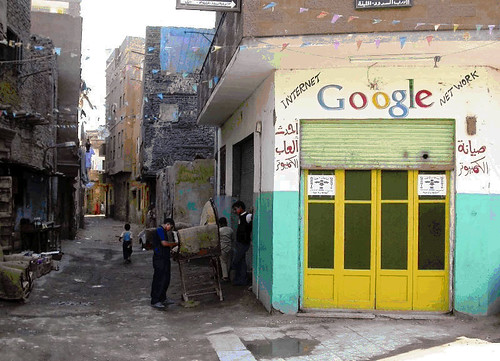
Early last month the mayor of Topeka, Kansas stunned the world by announcing that his city was changing its name to Google. We’ve been wondering ever since how best to honor that moving gesture. Today we are pleased to announce that as of 1AM (Central Daylight Time) April 1st, Google has officially changed our name to Topeka.


We didn’t reach this decision lightly; after all, we had a fair amount of brand equity tied up in our old name. But the more we surfed around (the former) Topeka’s municipal website, the more kinship we felt with this fine city at the edge of the Great Plains.

In fact, Topeka Google Mayor Bill Bunten expressed it best: “Don’t be fooled. Even Google recognizes that all roads lead to Kansas, not just yellow brick ones.”

For 150 years, its fortuitous location at the confluence of the Kansas River and the Oregon Trail has made the city formerly known as Topeka a key jumping-off point to the new world of the West, just as for 150 months the company formerly known as Google has been a key jumping-off point to the new world of the web. When in 1858 a crucial bridge built across the Kansas River was destroyed by flooding mere months later, it was promptly rebuilt — and we too are accustomed to releasing 2.0 versions of software after stormy feedback on our ‘beta’ releases. And just as the town's nickname is "Top City," and the word “topeka” itself derives from a term used by the Kansa and Ioway tribes to refer to “a good place to dig for potatoes,” we’d like to think that our website is one of the web's top places to dig for information.

In the early 20th century, the former Topeka enjoyed a remarkable run of political prominence, gracing the nation with Margaret Hill McCarter, the first woman to address a national political convention (1920, Republican); Charles Curtis, the only Native American ever to serve as vice president (’29 to ‘33, under Herbert Hoover); Carrie Nation, leader of the old temperance movement (and wielder of American history’s most famous hatchet); and, most important,Alfred E. Neuman, arguably the most influential figure to an entire generation of Americans. We couldn’t be happier to add our own chapter to this storied history.

A change this dramatic won’t happen without consequences, perhaps even some disruptions. Here are a few of the thorny issues that we hope everyone in the broader Topeka communitywill bear in mind as we begin one of the most important transitions in our company’s history:
  • Correspondence to both our corporate headquarters and offices around the world should now be addressed to Topeka Inc., but otherwise can be addressed normally.
  • Google employees once known as “Googlers” should now be referred to as either “Topekers” or “Topekans,” depending on the result of a board meeting that’s ongoing at this hour. Whatever the outcome, the conclusion is clear: we aren’t in Google anymore.
  • Our new product names will take some getting used to. For instance, we’ll have to assure users of Topeka News and Topeka Maps that these services will continue to offer news and local information from across the globe. Topeka Talk, similarly, is an instant messaging product, not, say, a folksy midwestern morning show. And Project Virgle, our co-venture with Richard Branson and Virgin to launch the first permanent human colony on Mars, will henceforth be known as Project Vireka.
  • We don’t really know what to tell Oliver Google Kai’s parents, except that, if you ask us, Oliver Topeka Kai would be a charming name for their little boy.
  • As our lawyers remind us, branded product names can achieve such popularity as to risk losing their trademark status (see cellophane, zippers, trampolines, et al). So we hope all of you will do your best to remember our new name’s proper usage:
Finally, we want to be clear that this initiative is a one-shot deal that will have no bearing on which municipalities are chosen to participate in our experimental ultra-high-speed broadband project, to which Google, Kansas has been just one of many communities to apply.